Everyone Has a Podcast and Nobody Has Anything to Say: The Celebrity Guest Rotation That Ate the Medium
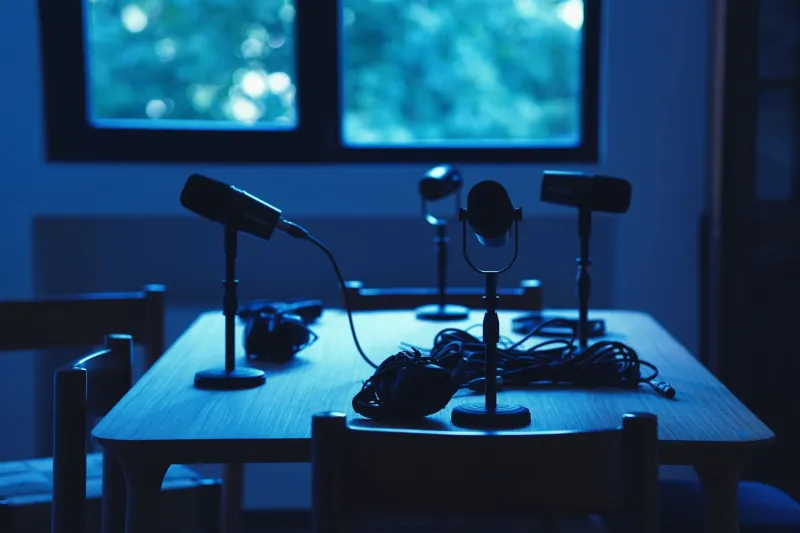
There is, at this exact moment, a celebrity recording a podcast episode. Somewhere in a soundproofed studio that costs more per hour than your monthly rent, a person whose face you recognize is speaking into a microphone about something you will not remember in forty-eight hours. Their co-host — another celebrity, or possibly an influencer, or possibly someone whose job title is literally just "personality" — is nodding enthusiastically.
In the hallway outside, a publicist is already scheduling a guest appearance on a different podcast, where this same celebrity will discuss the same three topics they always discuss: their childhood, their "process," and whatever project they're currently promoting. The guest appearance will be described, in a press release nobody asked for, as "a candid conversation."
It will not be candid. Nothing about any of this is candid. And yet here we are, drowning in it.
How We Got Here: A Tragedy in Three Acts
Act One: Joe Rogan Made It Look Easy
The celebrity podcast explosion has a specific origin story, and it involves a comedian sitting in a room talking to people for three hours. Whatever you think about Joe Rogan — and the options range widely — his success convinced an entire generation of celebrities that the barrier to entry for compelling audio content was basically zero. Just talk. Just have guests. Just be interesting for ninety minutes twice a week.
What they missed, and continue to miss, is that the interesting part was never the format. The format is a microphone and a chair. The interesting part is either genuine chemistry, genuine expertise, or genuine weirdness — and those things cannot be manufactured by a PR team, no matter how many "authentic conversation" strategy sessions they hold.
Act Two: The Pandemic Made Everyone Desperate
2020 handed celebrities something they'd never had before: unstructured time and a captive audience with nowhere to go. Podcasts launched at a rate that can only be described as geological. Every actor who'd been meaning to "do something creative" suddenly had the bandwidth to do it, and "something creative" turned out to mean "record conversations with my famous friends in my guest house."
Some of these were fine. Most were not. All of them are technically still in existence somewhere in the RSS feed graveyard, last updated in November 2021, waiting for a Season Two that will never come.
Act Three: The Streaming Money Made It Worse
Then Spotify started writing checks with a lot of zeros on them, and the game changed entirely. Suddenly a podcast wasn't just a creative outlet — it was a revenue stream, a brand extension, and a contractual obligation. Celebrities who had never expressed any interest in audio content were suddenly hosting shows because the deal was too good to turn down.
The result is what you'd expect when financial incentive replaces creative motivation: technically competent, spiritually hollow content delivered on a reliable schedule to an audience that's slowly figuring out they could be doing literally anything else with their ears.
The Guest Host Situation, Which Is Its Own Special Disaster
Beyond the celebrity who hosts their own show, there's a second category that deserves its own investigation: the celebrity who appears as a guest host on someone else's show. This phenomenon has become so common that it now constitutes its own ecosystem, with its own unwritten rules and its own particular flavor of meaninglessness.
Here's how it works. A podcast has a regular host. The regular host takes a week off, or is busy, or has decided that rotating guest hosts makes their show feel "dynamic" and "fresh." A celebrity is brought in — usually someone with a project to promote — to host for an episode or a week. They interview guests they already know. They discuss topics they've discussed before. They mention their new movie/show/book/fragrance line approximately four times in what is supposed to be a casual aside.
The episode is promoted as a "special guest host edition." The celebrity posts about it on Instagram. Their publicist sends a press release. And somewhere, a listener who has been following the show for three years sits in their car thinking: why is this person here and where is the person I actually subscribed to hear from?
The Content Ouroboros: When Podcast Guests Promote Their Podcasts
We have reached a level of recursive absurdity that would make a philosophy professor cry. Celebrities now go on podcasts specifically to promote their own podcasts. The guest appearance, which once existed to give audiences new perspectives and hosts new material, has been fully colonized by the promotional machine.
The interview goes like this: the host asks about the guest's new project. The guest mentions their show. The host, who has also been a guest on the guest's show, mentions that appearance. The guest mentions that the host should come back on soon. The host agrees. They discuss this potential future podcast appearance for four minutes. Everyone laughs. It's a great episode, according to the newsletter that recaps it.
This is content. This is what content has become. Two famous people discussing the logistics of producing more content about themselves, packaged as entertainment and delivered to you through a service you pay for.
What a Good Podcast Actually Requires (Hint: Not Fame)
The dirty secret of the celebrity podcast explosion is that fame is almost entirely orthogonal to what makes audio content compelling. The podcasts people actually evangelize to their friends — the ones they describe as "life-changing" or "I listened to the whole back catalog in two weeks" — are almost never hosted by people you'd recognize at a grocery store.
They're hosted by obsessives. People who know one thing very deeply, or who are genuinely curious about everything, or who have developed a voice so specific that listening feels like being let in on a private joke. None of these qualities are distributed along celebrity lines. Some famous people have them. Most don't. And the ones who don't are currently recording their forty-seventh episode with a co-host who keeps saying "no, totally, yeah" as a verbal tic.
The Cancellation That Will Not Come
The most dispiriting part of all this is that the celebrity podcast bubble, unlike most bubbles, doesn't seem particularly interested in popping. Downloads are notoriously unverifiable. Ad rates remain high enough to justify mediocre content. And the sunk cost of a studio setup, a production team, and a branding package means everyone keeps recording long after any reasonable person would have quit.
So the guest rotation continues. The special host editions pile up. The RSS feeds grow longer and less listened-to. And somewhere, right now, a celebrity is wrapping up an episode by saying "make sure you subscribe, leave us a five-star review, and we'll see you next week" — to an audience that is, statistically, mostly their own publicist.
Five stars. Totally.